

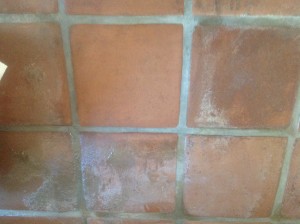
Unless you are partying at Charlie Sheen’s or Tony Montana’s house the white powder is almost certainly efflorescence.
It may sound serious but efflorescence is just a fancy word for salts that migrate to the surface. It is a normal phenomenon that can be seen in clay brick, concrete, mortar, grout, and in all types of masonry.
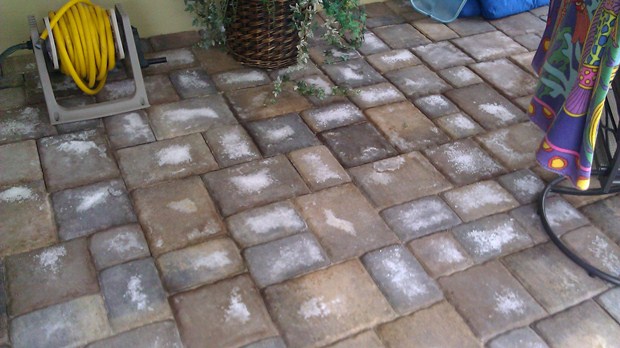
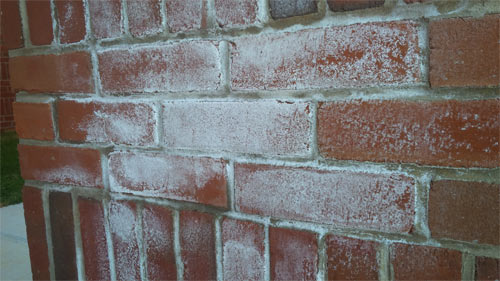
ARTO uses an efflorescence reducing admixture in our concrete mix so our products will have a minimal amount of salts. Water is necessary to transport these salts to the surface so efflorescence is almost never seen in interior applications (the only one I ever saw was from a broken water line to a refrigerator).
Efflorescence can sometimes occur outdoors but will usually exhaust itself as there is a finite amount of salts in mortar, grout, and concrete. However, nearby soils and planter beds contain large amounts of salts and can lead to recurring efflorescence. Flower pots and planter can also transport efflorescence in runoff water.
Water management including proper drainage and sprinkler placement can minimize efflorescence by limiting water that can transport salts to the surface.
How do you clean efflorescence?
1. NEVER USE ACID OR HARSH CHEMICALS as these can remove sealers and damage concrete surfaces.
2. In many cases efflorescence can simply be hosed off or brushed away when it is powdery.
3. Recurring or hardened efflorescence may require a specialized cleaner. We like Aldon Efflorescence Treatment as it is does not contain acids like many similar products.
How can you minimize the potential for efflorescence?
1. Use a high quality penetrating or breathable topical sealer for exterior installations. Most topical sealers will trap efflorescence and moisture under the sealed surface. Stripping the sealer (a messy and hazardous process that can damage the tiles) is the only way to remove the efflorescence.
2. Design and direct sprinklers to minimize water landing on the tiles. Remember, without water there is no way to transport the salts to the surface.
3. Keep flower pots and planters elevated and use drip irrigation systems to minimize runoff from these features.
4. Install a waterproofing membrane underneath the tiles in order to minimize water intrusion from the concrete slab and soil beneath. It is important to lap up the membrane at the perimeter in order to prevent water from entering from the sides.